Successful Hydrocelectomy for Right Hydrocele in a 62 Y.O. Male
PACE Hospitals
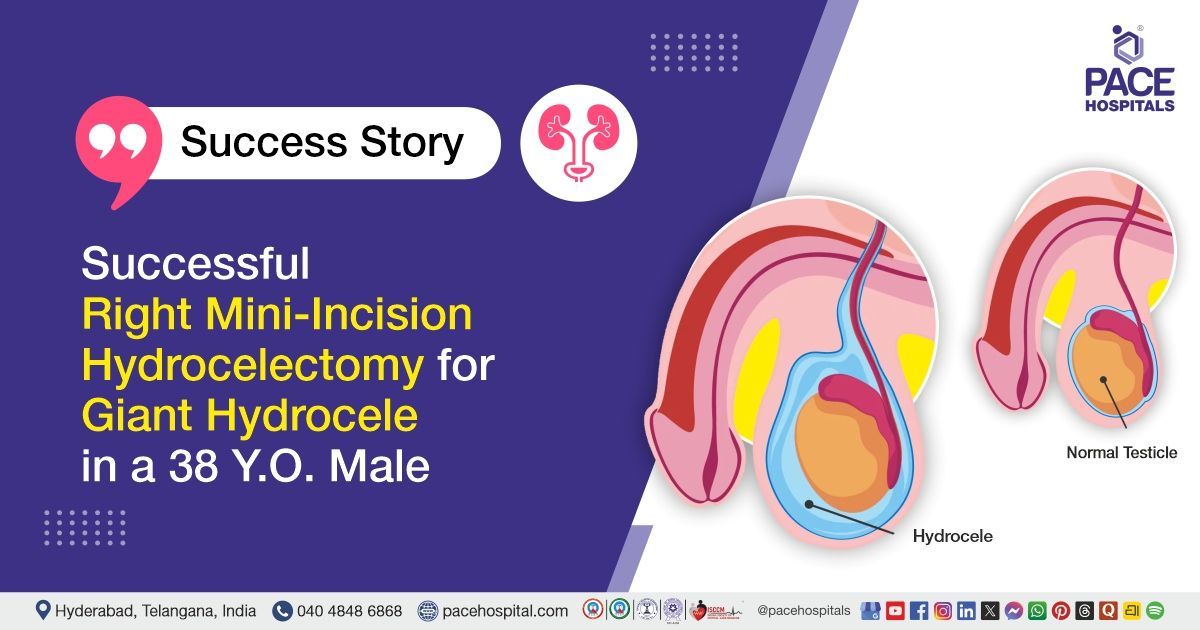
PACE Hospital’s expert Urology team successfully performed a Right Hydrocelectomy on a 62-year-old male patient who presented with right scrotal swelling. The aim of removing the fluid-filled sac (hydrocele) around the testicle is to relieve swelling and discomfort, restore normal scrotal size, and prevent recurrence of fluid accumulation.
Chief Complaints
A 62-year-old male patient with a body mass index (BMI) of 21 presented to the Urology Department at PACE Hospitals, Hitech City, Hyderabad, with complaints of swelling in the right side of the scrotum.
Past Medical History
The patient had a known history of hypertension and chronic respiratory disease in the form of asthma–COPD. He also had a past history suggestive of a transient ischemic attack (TIA).
On Examination
On examination, the patient was conscious, coherent, and oriented. His general physical condition was normal. Cardiovascular assessment revealed normal heart sounds with no murmurs or additional abnormal findings. Respiratory system evaluation was normal with no signs of wheezing or crepitations. Abdominal examination was normal, with no organomegaly or tenderness.
Local examination of the scrotum revealed a right-sided swelling consistent with a moderate hydrocele, while the testes and epididymides were normal in size, shape, and consistency. Peripheral pulses and neurological examination were normal.
Diagnosis
Upon admission to PACE Hospitals, the patient was thoroughly evaluated by the Urology team, including a detailed review of his medical history and a comprehensive clinical examination. Presented with right scrotal swelling, there was clinical suspicion of a scrotal pathology such as hydrocele or other fluid collection.
The patient underwent diagnostic investigations, including a scrotal ultrasound, which confirmed the presence of a right-sided moderate hydrocele with normal testes and epididymides, and no evidence of varicocele. Laboratory investigations, including complete blood picture, renal function tests, blood sugar, coagulation profile, serum electrolytes, and viral screening for HIV, Hepatitis B, and C, were all within normal limits. Echocardiography and arterial blood gas analysis were normal. Cardiovascular, abdominal, and neurological examinations were normal. Respiratory system examination was stable, with no acute wheezing or crepitations noted, consistent with his history of asthma–COPD.
Based on the confirmed findings, the patient was advised to undergo Right-sided Hydrocele Treatment in Hyderabad, India, under the expert care of the Urology Department.
Medical Decision Making (MDM)
After a detailed consultation with Dr. Abhik Debnath, Consultant Laparoscopic Urologist, and cross-consultations with Dr. Pradeep Kiran Panchadi, Consultant Pulmonologist, in view of the patient’s history of Asthma-COPD, and Dr. S Pramod Kumar, Consultant Neurologist, in view of the patient’s history suggestive of prior TIA, a comprehensive evaluation was conducted focusing on the patient’s presentation of right scrotal swelling and the diagnostic findings. Clinical and diagnostic findings confirmed the presence of a right-sided moderate hydrocele with no evidence of testicular pathology, epididymal abnormality, or infection.
It was determined that right hydrocelectomy was identified as the most appropriate intervention to alleviate the patient's symptoms and to prevent progression or complications.
The patient and his family members were informed about the diagnosis of right-sided hydrocele, the planned surgical management, the associated risks, and the expected benefits aimed at relieving symptoms and preventing further complications.
Surgical Procedure
Following the decision, the patient was scheduled for Right Hydrocelectomy Surgery in Hyderabad at PACE Hospitals, under the expert care of the urology department.
The procedure involved the following steps:
- Anesthesia and Preparation: Spinal anesthesia was administered to provide analgesia and patient comfort. The patient was positioned supine, and standard aseptic precautions were followed. The right scrotal area was cleaned and draped appropriately. Vital signs were continuously monitored throughout the procedure.
- Incision: A small transverse incision was made over the right hemiscrotum, carefully exposing the underlying tissues. Hemostasis was maintained using meticulous dissection techniques.
- Hydrocele Sac Dissection: The hydrocele sac was identified and carefully dissected from surrounding tissues, ensuring preservation of the testis, epididymis, and spermatic cord structures.
- Hydrocele Sac Management: The hydrocele sac was opened, and clear fluid was aspirated. The sac was then excised, and the edges were either oversewn or everted to prevent recurrence. The testis and epididymis were inspected and found to be normal.
- Closure: The scrotal layers were closed in anatomical layers using absorbable sutures. A sterile dressing and scrotal support were applied. The patient tolerated the procedure well, and there were no intraoperative complications.
Postoperative Care
After surgery, the patient was closely monitored and remained stable throughout his hospital stay. His intraoperative and postoperative course was uneventful, with no complications observed. He received medications for pain relief and infection prevention as needed, and the surgical site was managed appropriately. The patient was discharged in stable condition.
Discharge Medications
The patient was prescribed medications for infection prevention, pain relief as needed, reduction of inflammation, and support for tissue healing. Additionally, he was advised to continue his routine medications for neurological conditions and respiratory support.
Advice on Discharge
The patient was advised to avoid heavy lifting and bending forward for two weeks. He was instructed to use scrotal support and maintain daily wound care as directed.
Emergency Care
The patient was instructed to contact the emergency ward at PACE Hospitals in the event of an emergency or if symptoms such as fever, scrotal pain, or pus discharge.
Review and Follow-up Notes
The patient was advised to return for a follow-up visit with the Urologist in Hyderabad at PACE Hospitals after 4 days for dressing.
Conclusion
This case highlights the management of a right-sided moderate hydrocele in a patient with comorbidities. After comprehensive evaluation and cross-consultations, a right hydrocelectomy was performed with an uneventful intraoperative and postoperative course. The patient’s recovery was smooth, symptoms were effectively managed, and he was discharged in a stable condition with instructions for appropriate follow-up.
Multidisciplinary Approach for Optimal Recovery in Right Hydrocelectomy
A comprehensive perioperative strategy, in coordination with pulmonology and neurology specialists, ensured all comorbidities were addressed before surgery. The procedure was performed with precise technique, minimizing tissue trauma and reducing the risk of complications. Postoperative management focused on careful monitoring of vital signs, effective pain control, and prevention of infection. Supportive measures, including scrotal care, activity modification, and structured follow-up, facilitated early mobilization and smooth recovery. This integrated approach highlights how the active involvement of the urologist/urology doctor, combined with multidisciplinary collaboration, enhances surgical outcomes and ensures patient safety even in individuals with complex medical backgrounds.
Share on
Request an appointment
Fill in the appointment form or call us instantly to book a confirmed appointment with our super specialist at 04048486868
Appointment request - health articles
Recent Articles