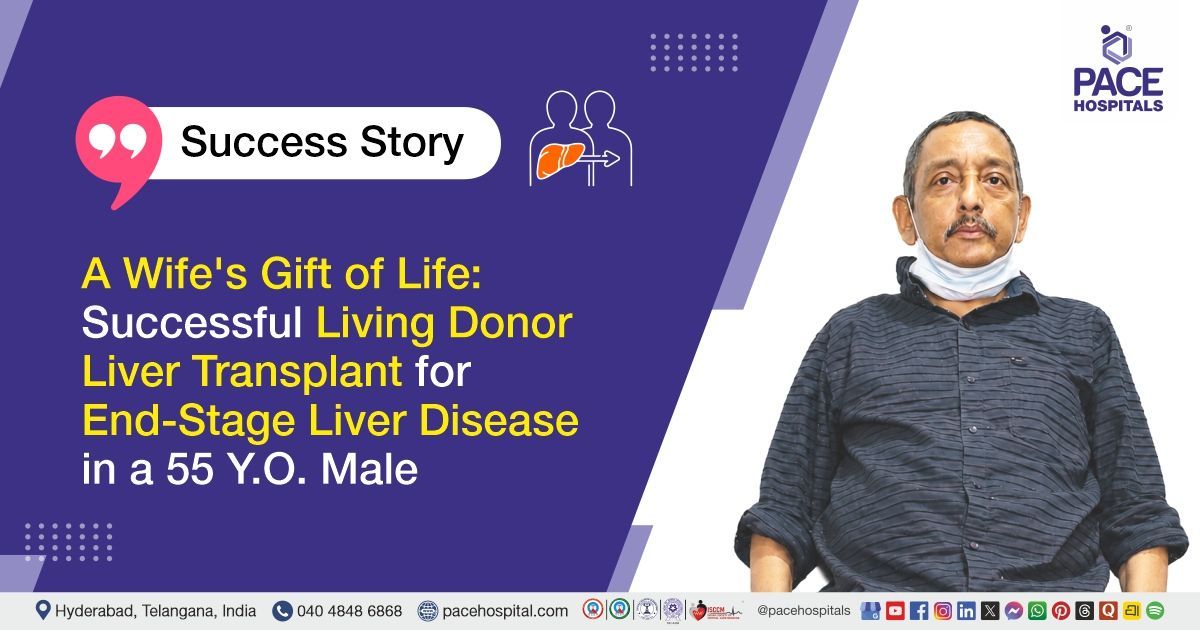
A Wife's Gift of Life: Successful Living Donor Liver Transplant for End-Stage Liver Disease
PACE Hospitals
PACE Hospitals’ expert Liver Transplant Team successfully performed a Living Donor Liver Transplantation (LDLT) on a 55-year-old male patient diagnosed with decompensated chronic liver failure associated with portal hypertension, ascites, hepatic encephalopathy, and hepatorenal syndrome. The procedure was performed using a right lobe modified liver graft donated by the patient's wife, restoring liver function and offering a life-saving treatment for end-stage liver disease.
Chief Complaints
A 55-year-old male patient with a body mass index (BMI) of 17 presented to the Liver Transplant Department at PACE Hospitals, Hitech City, Hyderabad, with complaints of abdominal distension and altered mental status. He was admitted for comprehensive evaluation and further management.
Past Medical History
The patient was a known case of diabetes mellitus and chronic liver disease. He had undergone multiple Endoscopic Variceal Ligation (EVL) banding procedures in the past for complications related to portal hypertension.
On Examination
On examination, the patient was conscious but had altered sensorium. He appeared clinically ill with features of chronic liver disease. Abdominal examination revealed ascites, with clinical signs suggestive of portal hypertension. No focal neurological deficits were noted, and the remaining systemic examination was stable enough to proceed with further liver transplant evaluation.
Diagnosis
Upon admission to PACE Hospitals, following the clinical assessment, the Liver Transplant Team conducted a comprehensive evaluation based on the patient's complaints of abdominal distension and altered sensorium in a known case of chronic liver disease with hepatic encephalopathy. A detailed medical history, physical examination, and pre-transplant assessment were performed to determine the severity of liver dysfunction, identify associated complications, and evaluate the patient's suitability for liver transplantation.
Baseline investigations, including complete blood picture, liver function tests, renal function tests, serum electrolytes, coagulation profile (PT/INR, APTT), blood glucose levels, inflammatory markers, viral screening, blood grouping and cross-matching, arterial blood gas analysis, and other routine pre-transplant laboratory investigations, were carried out as part of the transplant workup. The severity of liver disease was further assessed using prognostic scoring systems, which revealed a Model for End-Stage Liver Disease (MELD)-Na score of 32 and a Child-Turcotte-Pugh (CTP) Grade C, indicating advanced liver failure.
Imaging and diagnostic studies, including ultrasonography of the abdomen, liver Doppler examination, CT imaging where indicated, chest X-ray, electrocardiography, and 2D echocardiography, were performed as part of the comprehensive transplant evaluation. These investigations demonstrated features consistent with advanced chronic liver disease, including portal hypertension, ascites, hepatic encephalopathy, and hepatorenal syndrome, confirming decompensated end-stage liver disease.
Based on the confirmed diagnosis, the patient was advised to undergo End-Stage Liver Disease Treatment in Hyderabad, India, under the care of the liver transplant team, with the objective of restoring liver function, preventing further life-threatening complications, and improving long-term survival.
Medical Decision Making (MDM)
After a thorough evaluation by Dr. Govind Verma, (Transplant Hepatologist), and Dr. CH Madhusudhan, (Liver Transplant Surgeon), a comprehensive assessment was carried out to determine the most appropriate management plan for the patient diagnosed with decompensated chronic liver failure.
Based on the clinical findings of chronic liver disease with abdominal distension, altered sensorium, hepatic encephalopathy, portal hypertension, ascites, hepatorenal syndrome, high MELD-Na score of 32, and Child-Turcotte-Pugh Grade C status, it was determined that Living Donor Liver Transplantation (LDLT) was the most appropriate life-saving treatment approach. This decision was made after careful evaluation of the severity of liver dysfunction, associated complications, transplant fitness, and the need for definitive restoration of liver function.
The patient, donor, and family members were counselled regarding the condition, the need for liver transplantation, associated risks and benefits, donor evaluation, possible complications, lifelong immunosuppressive therapy, infection prevention, medication adherence, and the importance of regular postoperative follow-ups.
Surgical Procedure
Following the decision, the patient was scheduled to undergo Living Donor Liver Transplantation (LDLT) in Hyderabad at PACE Hospitals under the expert care of the liver transplant team.
The procedure involved the following steps:
- Patient Preparation and Anaesthesia: After completion of donor and recipient evaluation, pre-anaesthesia check-up (PAC), and obtaining informed consent, both the donor and recipient were shifted to the operating theatre. Under strict aseptic precautions, general anaesthesia was administered, and appropriate vascular access and invasive monitoring were established to ensure safe intraoperative management.
- Donor Right Lobe Liver Graft Procurement: The patient's wife underwent donor hepatectomy, during which the right lobe of the liver was carefully mobilized and harvested while preserving adequate liver volume for the donor. The graft was inspected, flushed with preservation solution, and prepared for transplantation after confirming satisfactory vascular and biliary anatomy.
- Recipient Hepatectomy and Native Liver Removal: The diseased cirrhotic liver was carefully dissected and removed. Major vascular structures, including the inferior vena cava, portal vein, hepatic artery, and bile duct, were meticulously prepared to facilitate implantation of the donor liver graft while minimizing blood loss.
- Liver Graft Implantation and Vascular Reconstruction: The right lobe modified liver graft was implanted into the recipient. Sequential reconstruction of the hepatic veins, portal vein, hepatic artery, and biliary tract was performed to restore normal blood circulation and bile drainage. Adequate graft perfusion was confirmed after completion of all vascular anastomoses.
- Hemostasis, Graft Assessment, and Surgical Closure: After ensuring satisfactory liver graft function, haemostasis was secured, and the graft was assessed for adequate blood flow using intraoperative Doppler assessment. Surgical drains were placed as required, and the abdominal incision was closed in layers. The patient was then shifted to the
intensive care unit (ICU) for close postoperative monitoring and further management.
Postoperative Care
The patient was closely monitored in the intensive care unit, where liver graft function, blood circulation to the transplanted liver, blood sugar levels, and overall vital parameters were regularly assessed. Supportive treatment was provided to prevent organ rejection, control infection, relieve pain, protect the stomach, maintain nutritional status, and manage blood glucose levels. On the ninth postoperative day, a sudden episode of bloody drain output was observed and managed conservatively with close monitoring. Doppler examination confirmed good graft perfusion without any evidence of graft-related complications, and the patient was discharged in a hemodynamically stable condition with advice for regular follow-up.
Discharge Medications
Upon discharge, the patient was prescribed medications for prevention of organ rejection (immunosuppressive therapy), infection prevention, fungal prophylaxis, gastric protection, pain relief, fever control, nutritional supplementation, and other supportive medications as required following liver transplantation.
Advice on Discharge
The patient was advised to adhere to prescribed medications, including immunosuppressants, maintain a liver-friendly lifestyle, abstain from alcohol, monitor blood sugar regularly, and attend scheduled follow-up visits with routine investigations.
Emergency Care
The patient was informed to contact the emergency ward at PACE Hospitals in case of any emergency or development of symptoms such as fever, jaundice, severe abdominal pain, persistent vomiting, excessive wound discharge, breathing difficulty, reduced urine output, altered consciousness, or any other concerning symptoms.
Review and Follow-up Notes
The patient was advised to follow up with the Surgical Gastroenterologist in Hyderabad at PACE Hospitals, after 5 days.
Conclusion
This case highlights the successful management of advanced decompensated chronic liver failure through Living Donor Liver Transplantation (LDLT) using a right lobe modified liver graft. Timely diagnosis, multidisciplinary transplant planning, careful donor selection, and expert surgical management resulted in successful restoration of liver function and an uneventful recovery, demonstrating the effectiveness of living donor liver transplantation in suitable patients with end-stage liver disease.
Importance of Early Liver Transplantation in End-Stage Liver Disease
End-stage liver disease can lead to life-threatening complications such as portal hypertension, ascites, hepatic encephalopathy, hepatorenal syndrome, and severe coagulopathy. Although medications and supportive treatment help control symptoms temporarily, liver transplantation remains the only definitive treatment for suitable patients with advanced liver failure. Early referral to a Liver Transplant doctor/specialist allows timely evaluation before irreversible complications develop. Careful donor assessment, meticulous surgical technique, and structured postoperative follow-up significantly improve long-term survival and quality of life. Living donor liver transplantation also offers the advantage of reducing waiting time while providing excellent outcomes when performed in experienced transplant centres.
Frequently Asked Questions (FAQs)
When is a liver transplant the only treatment option for chronic liver failure?
A liver transplant is recommended when the liver is severely damaged and cannot recover or perform its normal functions. It is usually needed in patients with end-stage liver disease who develop serious complications such as portal hypertension, recurrent hepatic encephalopathy, ascites, or hepatorenal syndrome. At this stage, medicines may help control symptoms but cannot repair the damaged liver.
Can a family member donate part of their liver for transplantation?
Yes. A healthy family member with a compatible blood group may be able to donate a portion of their liver after completing a detailed medical evaluation. The donor's remaining liver and the transplanted portion in the recipient both have the ability to regenerate over time. Living donor liver transplantation also reduces the waiting time for surgery.
How is the donor selected for a living donor liver transplant?
The donor must be in good health, have a compatible blood group, and enough healthy liver tissue for safe donation. Doctors perform blood tests, liver scans, heart evaluation, and other medical examinations to ensure that donating the liver will be safe. The health and safety of both the donor and the recipient are always given equal importance.
What does a high MELD score mean before liver transplantation?
The MELD (Model for End-Stage Liver Disease) score helps doctors measure how severe the liver disease has become. A high MELD score means the liver is functioning very poorly and the patient has a greater risk of serious complications without a transplant. It also helps doctors decide how urgently a liver transplant is needed.
Can hepatic encephalopathy improve after a successful liver transplant?
Yes. Hepatic encephalopathy improves in many patients after a successful liver transplant. The new liver helps clear harmful toxins from the blood, allowing the brain to function better. During recovery, patients may become more alert and notice improvement in memory, concentration, and thinking. Recovery can differ from person to person, depending on overall health and the severity of brain involvement before transplant.
How long does recovery take after a living donor liver transplant?
Recovery is different for every patient and depends on their overall health before surgery. Most patients stay in the hospital for a few weeks so doctors can closely monitor the new liver. Complete recovery usually takes several months, during which regular follow-up visits, blood tests, a healthy diet, and proper medicines are essential.
Why are regular Doppler scans performed after liver transplantation?
A Doppler ultrasound is performed to check the blood flow to and from the transplanted liver. It helps doctors confirm that the liver arteries, veins, and portal vein are functioning properly. Regular Doppler scans can detect blood flow problems early, allowing timely treatment before they become serious.
Will diabetes affect recovery after liver transplantation?
People with diabetes can recover well after a liver transplant if their blood sugar is kept under good control. High blood sugar can slow wound healing and increase the risk of infections. Regular blood sugar monitoring, following dietary advice, and taking treatment as prescribed help support a smooth recovery.
Will I need lifelong treatment after a liver transplant?
Yes. Lifelong follow-up is necessary after a liver transplant. Patients need to take medicines regularly to prevent the body's immune system from rejecting the transplanted liver. Regular blood tests and check-ups help doctors monitor liver function, detect any problems early, and make changes to treatment whenever required.
What precautions should be followed after a liver transplant?
After a liver transplant, it is important to take medicines exactly as prescribed, attend all follow-up appointments, maintain good personal hygiene, avoid alcohol and smoking, and eat a balanced diet. Physical activity should be increased gradually as advised by the transplant team. Contact your doctor immediately if you develop fever, jaundice, severe abdominal pain, unusual swelling, vomiting, or discharge from the surgical wound.
Share on
Request an appointment
Fill in the appointment form or call us instantly to book a confirmed appointment with our super specialist at 04048486868
Appointment request - health articles
Recent Articles