World Hemophilia Day 17 April 2026 | Theme & Importance
PACE Hospitals
World Hemophilia Day is a global healthcare event celebrated on the 17th of April every year, started by the World Federation of Haemophilia (WHF) with the intention to raise a call for the government authorities and local policymakers for the provision of a better treatment and care in addition to promote better control and prevention with haemophilia.
A rare severe, inherited haemorrhagic disorder, haemophilia is caused by malfunction of factor VIII and factor IX protein (factors required for blood clotting/ coagulation), leading to an abnormality in blood coagulation. Although people of all races and ethnicities can be diagnosed with haemophilia, men are more likely to be affected because the ailment is connected to the X chromosome. There is a 50% probability that a boy whose mother carries the haemophilia gene will also be affected by haemophilia, and her daughter being 50% risk of being carrier. Hence, haemophilia is more common in males, despite the fact that it can affect females, causing difficulties with menstruation and childbirth.
World Hemophilia Day 2026 Theme
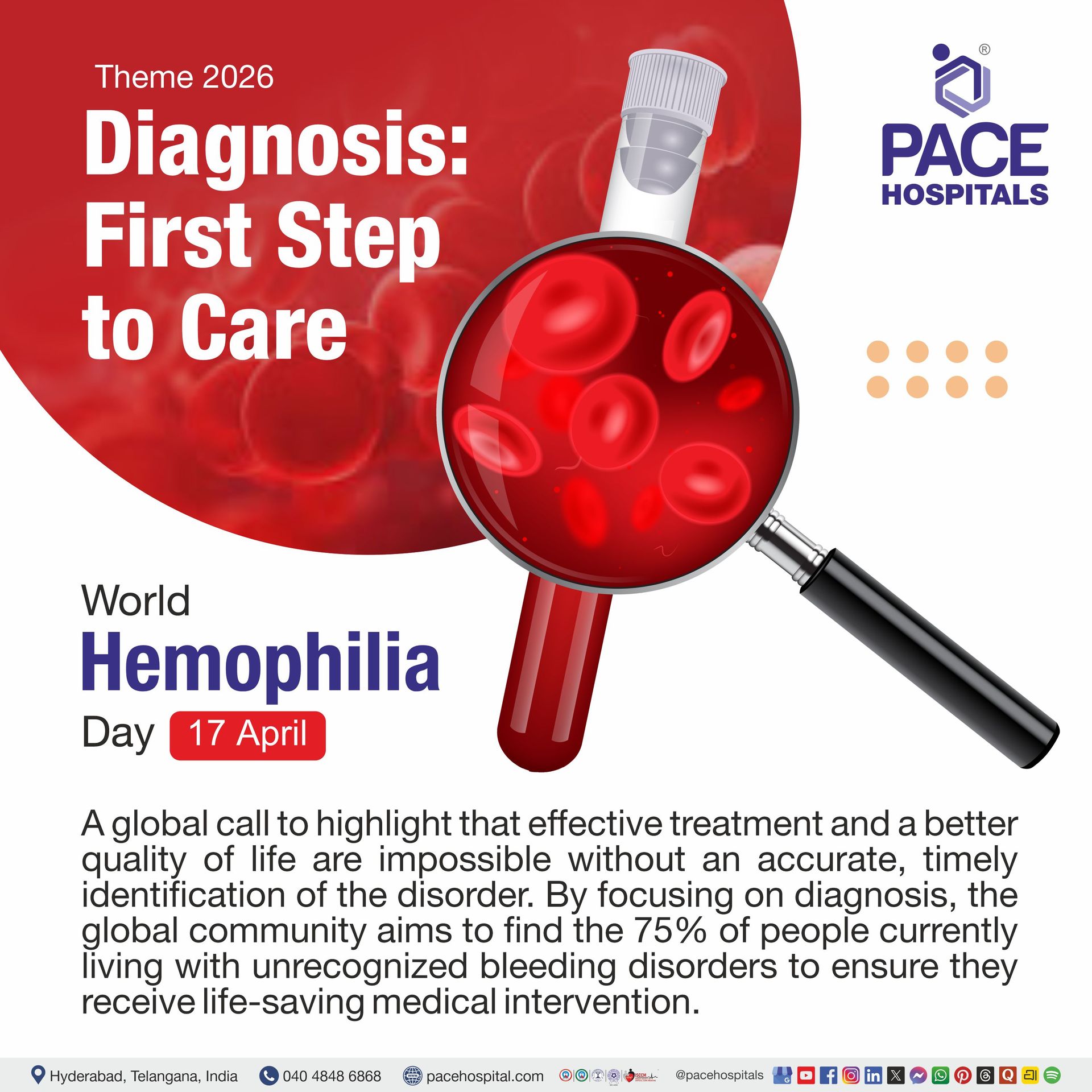
This year, 2026, World Hemophilia Day Theme is "Diagnosis: First Step to Care". This theme emphasizes that effective treatment and a better quality of life are impossible without an accurate, timely identification of the disorder. By focusing on diagnosis, the global community aims to find the 75% of people currently living with unrecognized bleeding disorders to ensure they receive life-saving medical intervention
Year-by-year themes for World Hemophilia Day:
- World Hemophilia Day 2025 theme: Access for All: Women and Girls Bleed Too
- World Hemophilia Day 2024 theme: Equitable access for all: recognizing all bleeding disorders
- World Hemophilia Day 2023 theme: Access for All: Prevention of bleeds as the global standard of care
- World Hemophilia Day 2022 theme: Access for All: Partnership. Policy. Progress
- World Hemophilia Day 2021 theme: Adapting to change: sustaining care in a new world
- World Hemophilia Day 2020 theme: Get involved to carry the motive of the World Federation of Hemophilia - Treatment for all
- World Hemophilia Day 2019 theme: Outreach and Identification
- World Hemophilia Day 2018 theme: Sharing knowledge makes us stronger
Importance of World Haemophilia Day
In 2000, it was estimated that 4 lakh persons, or around 1 in 10,000 live births, were affected by this disorder worldwide, and only 25% of those affected had access to adequate treatment. In 2019, however, a meta-analysis showed that the number of men with the inherited bleeding condition is far higher, at 11.25 lakh.
Even in high-income nations, only about 15% of the global population, has access to effective treatment for haemophilia. The lack of resources for diagnosis and treatment leads to high mortality and morbidity rates in low- and middle-income countries.
This year, World Haemophilia Day celebrates its 31st anniversary with activities focused on encouraging the public to support government and policymakers for the provision of better treatment, prevention, and control of bleeds in persons suffering from bleeding disorders.
History of World Haemophilia Day
World Haemophilia Day was first celebrated on the 17th of April 1989, by the World Federation of Haemophilia (WFH) to honour Frank Schnabel's birthday, the WFH's founder. Haemophilia wasn't discovered until the 10th century, when people started paying attention to the disproportionate number of male deaths from seemingly small accidents. This condition was referred to as abulcasis at the time. However, this could not be treated owing to technological constraints. An anticoagulant was commonly used to treat a disease that was rampant among royal families at the time; however, the anticoagulant thins the blood and worsens the condition.
In 1803, Dr John Conrad Otto of Philadelphia began researching "bleeders," who eventually concluded that the disease was passed down from mothers to sons. In 1937, haemophilia was classified as a type A or B genetic disorder. However, effective treatment had yet to be developed up to that point.
Share on
Request an appointment
Fill in the appointment form or call us instantly to book a confirmed appointment with our super specialist at 04048486868
Appointment request - health articles
Recent Articles