World Inflammatory Bowel Disease Day, 19 May 2026 - Theme, Importance & Preventions
PACE Hospitals
World Inflammatory Bowel Disease Day is a global healthcare event commemorated every year on the 19th of May to promote awareness of inflammatory bowel diseases (IBD) - Crohn's disease and ulcerative colitis worldwide. On this day, various global and local organisations step forward together to support a crore of people globally that suffer from inflammatory bowel diseases.
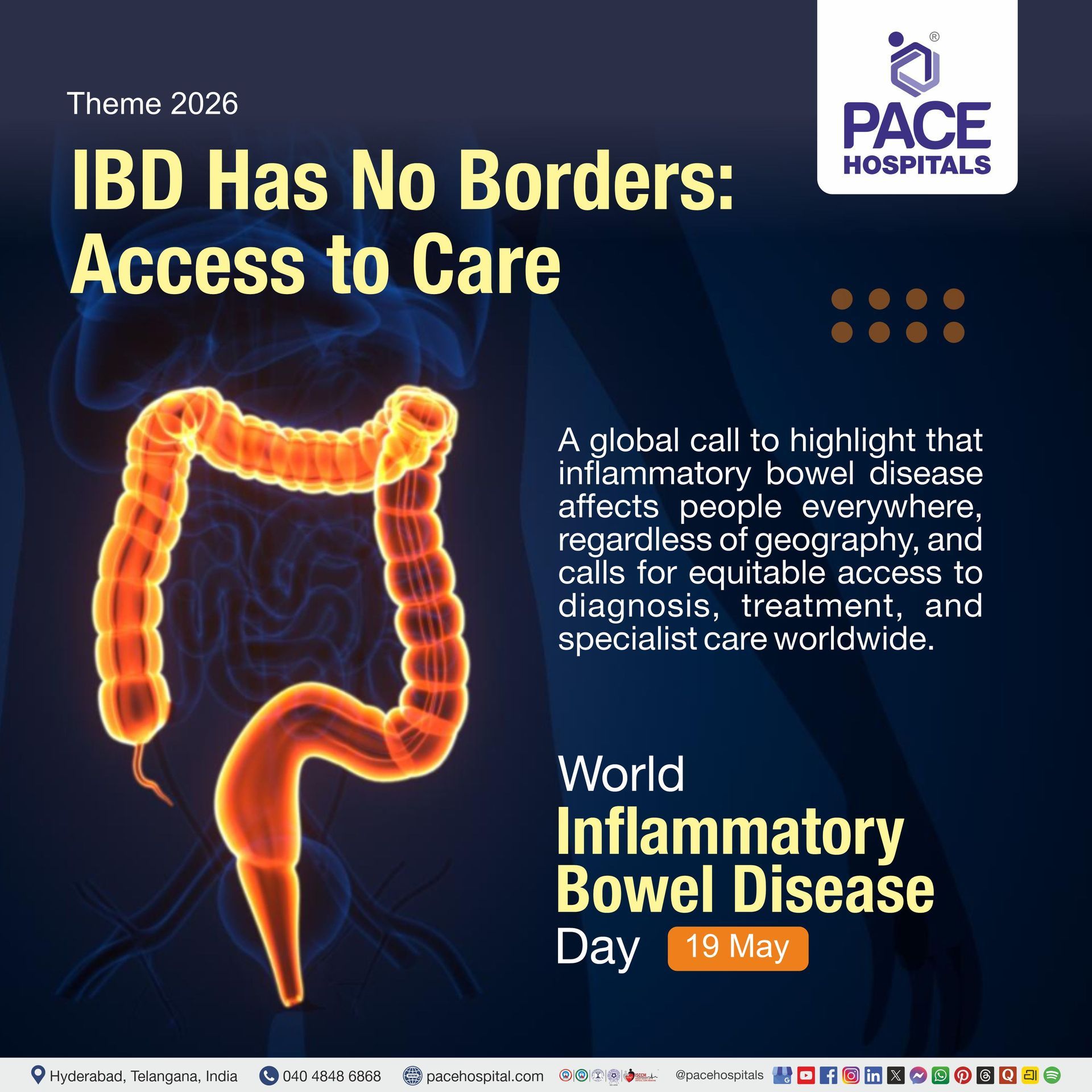
World Inflammatory Bowel Disease Day 2026 Theme
This year, 2026, the World Inflammatory Bowel Disease Day theme is "IBD Has No Borders: Access to Care”. The theme emphasizes that inflammatory bowel disease affects people everywhere, regardless of geography, and calls for equitable access to diagnosis, treatment, and specialist care worldwide.
Year By Year Themes for World Inflammatory Bowel Disease Day
- World Inflammatory Bowel Disease Day theme 2025: IBD Has No Borders: Breaking Taboos, Talking About It
- World Inflammatory Bowel Disease Day theme 2024: IBD Has No Borders
- World Inflammatory Bowel Disease Day theme 2023: IBD has no age
- World Inflammatory Bowel Disease Day theme 2022: IBD has no age
- World Inflammatory Bowel Disease Day theme 2021: Break the silence!
- World Inflammatory Bowel Disease Day theme 2020: Make IBD work
- World Inflammatory Bowel Disease Day theme 2019: Making the invisible visible
- World Inflammatory Bowel Disease Day theme 2018: Help us to raise awareness
Importance of World Inflammatory Bowel Disease Day (WIBDD)
Inflammatory Bowel Disease, which comprises ulcerative colitis and Crohn's disease, are two different diseases. In 10-15% of cases, it is difficult to distinguish between them, leading to unclassified IBD or indeterminate colitis. There has been an increasing trend of IBD in the Indian subcontinent and the financial burden it causes due to long-term treatment and constant monitoring.
The incidence and prevalence of IBD are increasing globally. It is reportedly higher in Western countries but is now being observed in Asian countries as well.
Epidemiological studies from China, Hong Kong, Japan, Korea, Malaysia, Singapore, Thailand, India, and Sri Lanka show that ulcerative colitis is more prevalent than Crohn's disease in South Asians, with a trend towards an increasing incidence of Crohn's disease.
IBD has NO AGE
Older people are often unfairly assumed to be frail, dependent, and a burden to society. The mindset towards the aged needs to be changed which cascades in reducing the discrimination against the elderly and the consequences can be seen in the society as a whole.
Health professionals, patient associations, and other stakeholders should work towards comprehensive approaches and policies that promote a good quality of life for elderly patients and combat ageism.
Modifications of Environmental Risk Factors in Treating IBD
Studies aimed at the increasing incidence in Asia suggested that diet and alterations in the composition of intestinal microbiota may interact with the immune system and lead to immune dysregulation in the gut, causing inflammatory bowel disorder.
Diet
Research suggests that dietary patterns and nutritional factors do influence the aetiology of inflammatory bowel disease.
- The Western diet, high in fats and refined sugars, along with low in fibre and vegetables, can inflame the gut.
- Refined carbohydrates and sweetened beverages also increase the risk but complex carbohydrates, fibre-rich vegetables and fruits are beneficial.
- Animal protein intake, especially from high protein diets, is also a risk factor forIBD.
- Food additives, such as detergents and emulsifiers, can cause increased bacterial adherence to the intestinal epithelium.
Exclusive enteral nutrition (EEN) is a dietary treatment that involves a completely liquid diet without any solid components for a certain duration. It has been found to be as effective in inducing remission and more effective in promoting mucosal healing, especially in paediatric patients with active Crohn's disease.
Intestinal microbiota and IBD
- The beneficial microbiota in our gut plays a crucial role in our health by influencing metabolite synthesis, barrier function, and immune responses.
- Dysbiosis (changes in gut microbial composition) can lead to chronic inflammatory responses leading to IBD and altering the microbial composition further.
Probiotics and prebiotics are used as potential treatments for IBD. Probiotics are live microorganisms that mimic the beneficial effects of healthy gut bacteria and have shown limited efficacy in treating ulcerative colitis. Prebiotics are non-digestible food components that ferment in the gut to produce beneficial components, such as short-chain fatty acids, and modify the gut microbiota.
Preventative tips to avoid IBD
- Fresh fruits and vegetables, prunes, and caffeinated beverages are among the things that may increase stool production.
- Reduce the consumption of intense sweets, such as juices, candies, and soda, to reduce the quantity of water drawn into the gut, which may lead to watery stools.
- Reduce alcoholism.
Share on
Request an appointment
Fill in the appointment form or call us instantly to book a confirmed appointment with our super specialist at 04048486868
Appointment request - health articles
Recent Articles